
A Guide to Planning Better Breaks
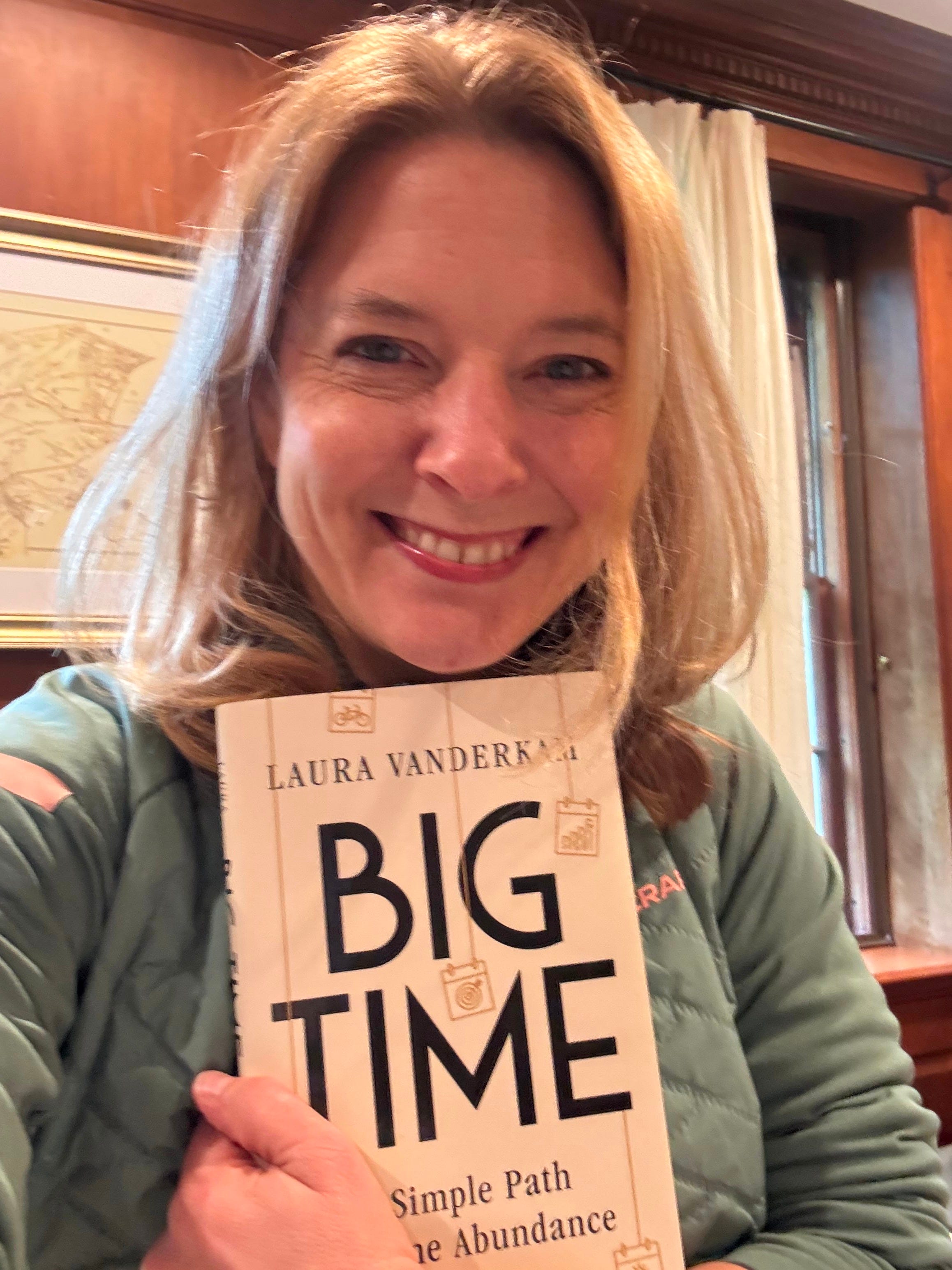
Laura Vanderkam, author of Big Time, shares her best scheduling hacks and how she manages interruptions.
Laura Vanderkam is one of the sharpest people writing about our relationship with time, answering questions like where does it go? Why does it feels so scarce? How can I feel like I have more of it?!
Her new book, Big Time: A Simple Path to Time Abundance, came out the same day as Body Electric, which was kinda perfect because while I’ve been reporting on what screen-filled, chair-bound days are doing to our bodies, Laura has been studying how those days get constructed in the first place. We both want people to embrace breaks and interruptions, an ethos that is counterintuitive to the typical American work ethic.
If you haven’t yet picked up your copy of Body Electric (or want to grab both books), click here…
So, in celebration of being book-birthday twins, Laura and I have traded Q&As. You can read my answers to her questions about why you don’t need a digital detox to have a healthier relationship with your tech. And below, we discuss her very precise scheduling methodology…
Answers have been lightly edited for length.
MZ: Many people might hear “planning” or “scheduling” and think ugh. But you love planning. Why?
Laura Vanderkam: Everyone reading this is a productive, responsible person. You will do the things you have to do. Wise planning means you’ll get to do the things you want to do too — and have a lot more time for fun. So that is why I love planning out my schedule.
I recommend that every busy person build a weekly planning ritual into their lives. These days, I sit down on Thursdays with my calendar and a new page in my planner and I think. I make myself a 3-category priority list. What is most important to me professionally over the next week? How about in my relationships (with family and friends)? What about for me personally? I imagine a lot of us think about our professional to-dos, but creating a 3-category priority list is a game changer. It’s hard to make a 3-category list and leave one category blank. Our brains don’t work that way. We think we need to put something in all three categories, and that, right there, can nudge you to have a more balanced life with some time for fun.
My life is occasionally a circus, but I like to think of myself as the ringmaster managing these three rings. And in keeping with this metaphor, a circus is generally managed for delight. If I create an intricate plan for the week where everyone gets where they need to go, but there’s nothing I’m genuinely looking forward to, then I need to go back and work on the schedule again. I promise if you do this weekly planning, week after week, life will not only be more calm, you’ll make space for joy as well.
MZ: What’s your message to people who feel guilty about taking breaks? As much as I want people to enjoy taking movement breaks, old ideas around productivity die hard.
LV: Sometimes people claim not to take breaks during their work days, but if you look at a lot of knowledge workers, the truth is that almost everyone does take breaks — it’s that the breaks aren’t particularly intentional or helpful. You’re checking email and you get a breaking news alert and you go read that headline and then see another article that irks you and next thing you know you’re reading down to the 43rd comment. This was a break but it didn’t feel rejuvenating.
As part of writing Big Time I had about 200 people try planning in two intentional work breaks per day. I had them think up breaks that would be rejuvenating, and think about where these could go. Curiously, when people were planning ahead, and knew they needed to slot in two breaks each day, they tended to choose two different sorts of breaks (a walk in the morning plus calling a friend in the afternoon; sitting outside in the morning for 10 minutes plus reading a novel in the afternoon for 10 minutes), a practice that added some nice variety to these mini-vacations, and that would have been hard to do without thinking it through. After a week of this, more people agreed that their work breaks were boosting their energy levels and boosting their moods — in other words, their breaks were getting better at doing what breaks are supposed to do.
Where this comes into play with time management is that while time isn’t renewable, energy is. We have at least some agency over our energy levels, and by pro-actively planning in breaks, we can be more energized and thus get more done than if we’re dragging. When energy is high we can also enjoy our time more. I’ve started taking a 5 p.m. walk to reset my energy for the evening. It’s easy to feel like we just want to collapse on the couch at the end of the day, but I’d like to enjoy my evenings, so I don’t want to feel exhausted.
MZ. I love the idea that energy is renewable even if time isn’t. Ok, last question: You and I both write about two kinds of interruptions: the external kind and self interruptions. How do you suggest people deal with them?
LV: Any time something feels draining or difficult, it helps to get data. I’d suggest people try tracking their time for a few days and noting when they were pulled away from an intended task, and why. Sometimes when people do this they find that a lot of interruptions are self-initiated. You were working on something challenging, and decided to check email as a little break. Could it have waited 15 minutes for a natural stopping point? Probably — but email was more appealing than struggle in the moment.
We all do this, but recognizing it is helpful because while we can’t always stop other people from interrupting us, we can usually stop interrupting ourselves. I like to keep what I call a “later list” going when I’m doing focused work. If I think of something I need to do or go find, I write it on the list to do…later. I won’t forget it if it’s written down, but there’s no need to do it right that second.
As for the other interruptions, some structural solutions can help. Even if you need to be fairly accessible, you might try being unavailable for short periods of time, and then available again. We can get a lot done in 15-20 focused minutes, and it’s the rare thing that can’t wait 15 minutes for a response (who knows - you might be in the bathroom then, or presenting in a meeting, or driving somewhere). If you work closely with a team, you might all agree on which hours you’ll be fully accessible to each other, and when you can all put your heads down and do focused work. That won’t eliminate interruptions, but might minimize a lot of them.
MZ: Indeed! Breaks are part of how we make the work possible. Thanks, Laura!
And…one week after pub day: Thank YOU, dear reader.
I am seriously grateful to everyone who bought Body Electric, came to an event, posted about it, told a friend, listened to the audiobook, wrote me a note saying , “Fine, I’ll go take a walk!” or just sent me good vibes via ESP.
I think we’re onto something here.
Maybe we can’t reach a peace deal with Iran today, but we can get more people feeling better in their bodies and improving their mood and focus…add it all up and who knows what’s possible tomorrow?
Meanwhile, a small but hugely helpful favor: If you’ve read the book or listened to the audiobook, would you leave a rating or short review? This one cracked me up:

Amazon, Goodreads, Audible, Libro.fm, Barnes & Noble, Bookshop, wherever you got it. Stars count! One word counts! “This made me dance” absolutely counts.
These early ratings really do help other people find the book.
Next week: the Rat Park experiment and what rodents can (and can’t) teach us about how we live with our technology.
x Manoush
P.S. I cajoled Daniel Tiger into taking a movement break with me at KQED fest in San Francisco on Saturday…

Love the Daniel Tiger photo. Big fan of Mr. Rogers and Daniel Tiger. I’m currently reading the book and loving it.